Table des matières
Why the new introduction of the QRC-HSN is relevant
The new QRC-HSN high-pressure screw-to-connect coupling is relevant because it addresses a central weak point in many hydraulic systems: the interface between the line and the consumer. Thanks to the combination of reduced pressure loss, increased corrosion resistance and a clearly defined assembly concept, it helps to make better use of hydraulic power, reduce the risk of failure and increase the availability of machines in challenging applications.
New QRC-HSN high-pressure screw-to-connect coupling as a further development of an established interface
screw-to-connect couplings from the QRC-HS series have been an integral part of demanding hydraulic applications in mobile and stationary hydraulics for many years. They have proven themselves wherever high pressures, strong pulses and harsh environmental conditions come together.
With the QRC-HSN, this tried and tested design principle has been systematically developed further. The new series is based on the familiar functionality, but adds technical improvements that have a direct impact on efficiency, robustness and operability. For OEMs and operators, the result is a high-pressure interface that meets current performance requirements and increasing demands on system availability.
Why high-pressure couplings influence the performance of hydraulic systems
Couplings are an integral part of the hydraulic flow path. Their influence on flow and pressure loss is often underestimated in system design, but in practice they have a direct effect on the usable performance.
A high pressure drop at the coupling can:
reduce the effective power at the consumer,
increase the energy requirement of the overall system,
cause additional heat development in the hydraulic oil.
With powerful machines in particular, the quality of the high-pressure clutch plays a decisive role in whether available drive power is utilised efficiently or lost unused.
Requirements from high-pressure and high-pulse hydraulics
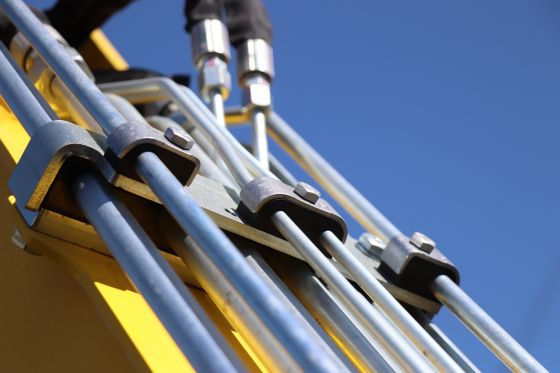
In many hydraulic applications, not only constant pressures are applied, but also dynamic loads. Pressure peaks, rapid load changes and vibrations are part of normal operation, for example in construction and mining machinery or other mobile equipment.
High-pressure couplings must be able to withstand these conditions:
remain permanently tight,
safely absorb mechanical loads,
function reliably even with repeated pulses.
The QRC-HSN is designed for such application profiles and enables the safe connection of hydraulic lines up to a nominal diameter of DN 38. High operating and burst pressure reserves form the basis for stable and long-lasting operation.
Reduced pressure loss thanks to optimised valve geometry
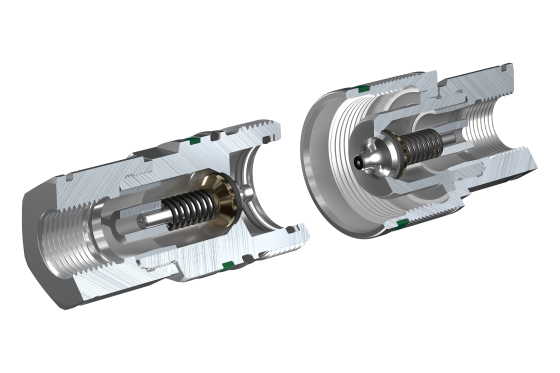
A central technical focus of the QRC-HSN lies in the revised design of the internal cone valves. The flow-optimised geometry reduces the pressure drop at nominal and maximum flow rates across all sizes.
In practice, this leads to
higher usable labour output,
improved energy efficiency of the system,
lower thermal load on the hydraulic oil.
This makes the high-pressure screw-to-connect coupling itself a relevant factor for the overall performance of hydraulic systems.
Corrosion resistance as a factor for availability and life cycle costs
ydraulic components used outdoors are constantly exposed to moisture, dirt and changing weather conditions. Corrosion can not only cause visual damage, but can also impair threads, sealing surfaces and valve functions.
The QRC-HSN is equipped with the STAUFF zinc-nickel surface, which offers significantly higher corrosion resistance than conventional galvanising. This contributes to,
reduce corrosion-related failures,
minimise leakage risks and
extend maintenance intervals.
Over the entire life cycle, this has a positive effect on the availability and operating costs of machines.
screw-to-connect coupling or plug-in coupling - a question of load
With high pressures, strong vibrations and frequent pressure peaks, the screw principle offers design advantages. The acting forces are transmitted evenly via the connecting thread and a large contact surface, which makes the connection particularly resistant.
Under such conditions, plug-in couplings can be subjected to mechanical stress due to repeated loads and suffer damage such as brinelling. screw-to-connect couplings are therefore the preferred solution for heavy-duty high-pressure and high-pulse hydraulics, where robustness and fatigue strength are paramount.
Assembly and operating concept from the user's perspective
In addition to the technical design, safe installation is a decisive factor for reliable operation. The QRC-HSN supports users with several practical features:
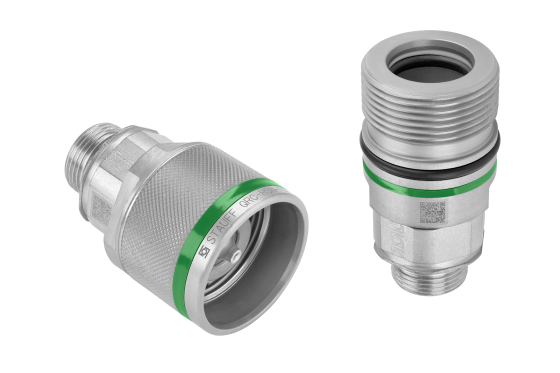
Clear laser labelling for component identification,
Colour coding rings for reliable assignment of socket and plug,
an external safety O-ring as a visual check for the correct and complete assembly of both coupling halves.
These elements reduce the risk of incorrect assembly and increase process reliability in the field and during maintenance.


Integration of the QRC-HSN into existing hydraulic systems
The QRC-HSN is fully downward compatible with the previous QRC-HS series. Existing couplings can be replaced without hydraulic modifications or used together with new components.
This enables:
a gradual modernisation of existing machinery,
for use in both original equipment and service,
the elimination of additional interfaces or duplicate warehousing.
FAQs
What is the QRC-HSN?
The QRC-HSN is a new high-pressure screw-to-connect coupling with cone valve that has been developed for demanding applications in mobile and stationary hydraulics and can safely handle high pressures and impulse loads.
How does the QRC-HSN differ from the previous QRC-HS?
The QRC-HSN offers optimised valve geometry with lower pressure loss, improved corrosion resistance thanks to zinc-nickel coating and additional features for safe assembly and identification.
Why are high-pressure screw-to-connect couplings suitable for heavy-duty applications?
screw-to-connect couplings distribute mechanical forces over a large contact area and are particularly resistant to the vibrations and pressure peaks that occur in high-pulse hydraulics.
What are the effects of reduced pressure loss on the coupling?
A lower pressure loss increases the usable hydraulic power, improves the energy efficiency of the system and can reduce the thermal load on the hydraulic oil.
Can the QRC-HSN be integrated into existing hydraulic systems?
Yes, the QRC-HSN is fully backwards compatible with the previous QRC-HS series and can be used without retrofitting existing hydraulic systems.

Newsletter subscription
Subscribe now and don't miss any new articles!