Table of contents
- Rönkhausen pumped storage plant: energy from differences in altitude
- How the pumped storage plant works - water as energy storage
- Hydraulics at the heart of the plant: spherical valves, pipes and control system
- Where STAUFF clamps are used in the Rönkhausen pumped storage plant
- Modernisation of the upper reservoir 2018/2019 - part of a long-term success story
- Energy path and panorama: technology you can experience
- FAQs
Recently discovered, now already on the STAUFF blog:
Some of the application photos shown in this and other blog posts come directly from our employees. This is because the internal STAUFF S³ app makes it incredibly easy for all STAUFF Group employees worldwide to document and informally submit applications for STAUFF products in everyday use. This provides authentic insights directly from the field. Thank you very much for the many great submissions!

Rönkhausen pumped storage plant: energy from differences in altitude
STAUFF clamps are used in the Rönkhausen pumped storage plant wherever cables need to be routed safely and oscillations and vibrations in the plant need to be reliably absorbed - thus helping to ensure that one of the most impressive energy plants in the Sauerland region can operate reliably.
The Rönkhausen pumped storage power plant has been stabilising the electricity grid since 1969 and balancing out fluctuations between generation and consumption - a task that is becoming increasingly important as the proportion of renewable energies grows.
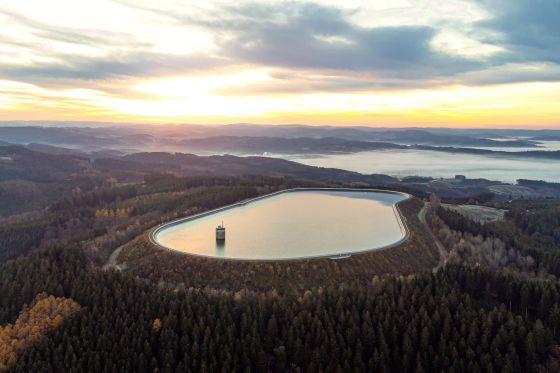
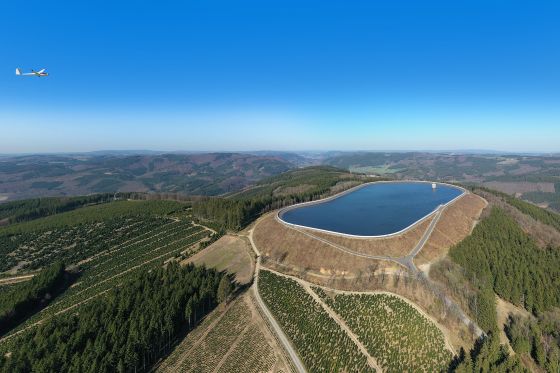
An upper reservoir with a capacity of around 1 million cubic metres was built on the Dahlberg near Rönkhausen. The lower reservoir with a capacity of around 1.3 million cubic metres is located around 270 to 300 metres below this in the Glinge valley. The difference in height between the upper and lower reservoirs forms the basis of the energy storage facility: up to 735,000 kWh of energy is stored in the upper reservoir, which is available within a short period of time if required.
How the pumped storage plant works - water as energy storage
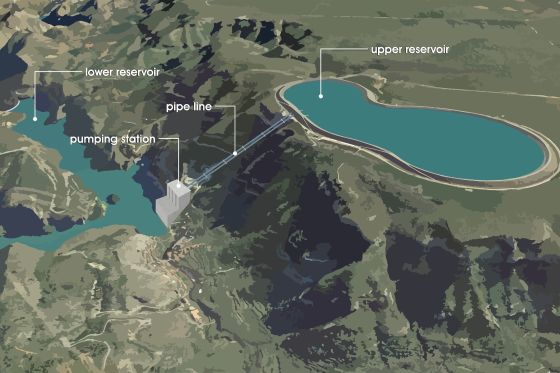
Pumped storage plants function like a large, rechargeable energy storage system. When little energy is required in the power grid or there is a surplus of electricity, water is pumped from the lower basin into the higher upper basin using electricity.
If the demand for electricity increases or there is less energy available from the wind or sun in the short term, the water flows back down via an almost one kilometre long pressure tunnel and drives the pump turbines in the powerhouse.
A few key figures illustrate the dimensions:
Height difference between upper and lower basin: approx. 300 metres
Water volume during turbine operation: approx. 67,000 litres per second from the upper basin
Operating time with filled upper basin: around 5 hours
Filling flow: approx. 44,000 litres per second when pumping up into the upper basin
The energy is not in the water itself, but in the potential energy from the height. This is how positional energy becomes electrical energy - flexible, plannable and controllable.
Hydraulics at the heart of the plant: spherical valves, pipes and control system
Precise and reliable control of the waterways is required for the pumped storage plant to be able to react so flexibly. The central elements are
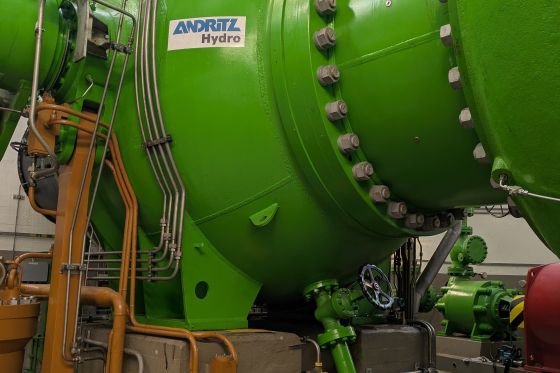
Ball valves: They open and close the pipes between the upper reservoir, pressure tunnel and powerhouse, thus enabling the switch between pump and turbine operation.
Pump turbines: The transition between pump operation (water upwards) and turbine operation (power generation) is realised in them.
Hydraulic and media lines: Oil, water and air lines perform control, regulation and supply functions in the system.
In these areas, lines must be securely fastened and clearly routed - both for reasons of operational safety and to minimise vibrations and noise. This is precisely where STAUFF clamps are used.
Where STAUFF clamps are used in the Rönkhausen pumped storage plant
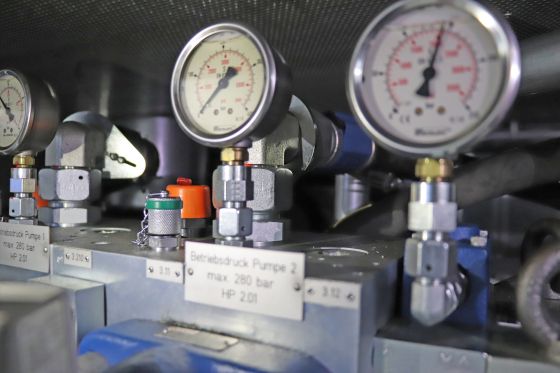
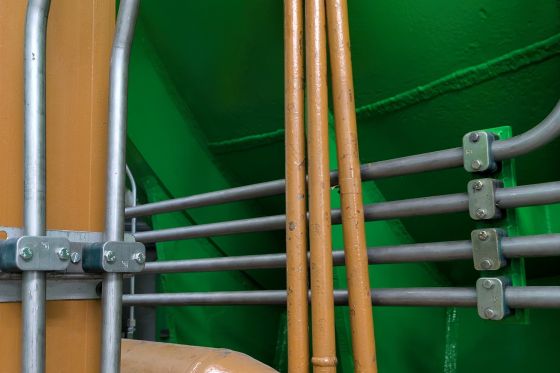
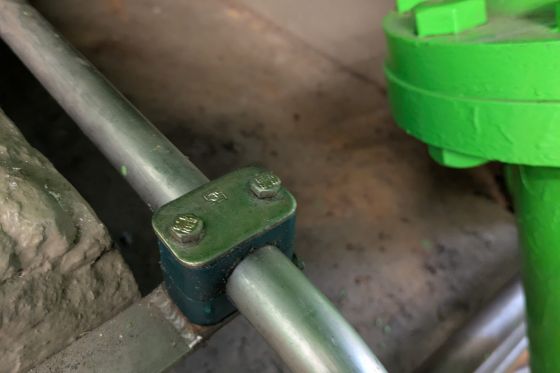
The well-known STAUFF clamps are installed in various places in the Rönkhausen pumped storage plant. They are particularly visible on a large spherical slide valve, where they securely guide various media lines:
Fastening oil lines that perform hydraulic control functions
Fixing of water and air lines required for control and regulation tasks, The main tasks of STAUFF clamps in this application:
Safe cable routing: cables are routed in a defined manner and held in position.
Vibration and noise reduction: Vibrations are reduced, which increases the service life of cables and components.
Protection against mechanical loads: The cables are protected against uncontrolled movements.
Cable protection helps to ensure that complex systems work reliably. STAUFF sees itself as a partner that provides high-performance components for demanding applications.
Modernisation of the upper reservoir 2018/2019 - part of a long-term success story
The Rönkhausen pumped storage plant is a facility with a history - and a future. In 2018/2019, the upper reservoir was extensively modernised and brought up to the latest technical standards. This modernisation is not a recent event, but part of a long-term maintenance and further development strategy.
The measures taken at the time included
Repair of the old sealing of the upper basin (approx. 100,000 m²)
Milling off the old asphalt surface and applying a new asphalt layer
Construction of an approximately 1.20 metre high wave protection wall to increase the storage capacity
Revision of the overflow sill at the lower basin
Major overhaul of the machine technology, including dismantling and factory overhaul of the pump turbines and ball valves
The refurbishment will help to ensure that the plant can be operated economically and safely until at least 2045. The STAUFF components are part of an overall system designed for longevity and reliability.
Energy path and panorama: technology you can experience
The upper reservoir is not only a technical structure, but also a popular destination for excursions. An approximately 1.3-kilometre-long, barrier-free circular path runs around the basin - the so-called energy path.
Information boards along the path provide insights into:
how the pumped storage power plant works
the contribution to stabilising the electricity grid
the role of renewable energies and storage technologies
At the same time, the site offers a 360-degree panoramic view of the Sauerland region. This makes it possible to vividly experience how modern energy technology, sustainable supply and landscape interact.
Other STAUFF products in pumped storage plants
It is not only the use of clamps that is relevant in pumped storage plants. Find out in our article how the STAUFF Form EVO system was used in the pumped storage plant in the Glarus Alpine valley
FAQs
Which cables can be fastened with STAUFF clamps in the pumped storage plant?
At the Rönkhausen pumped storage plant, STAUFF clamps are used to fasten oil, water and air pipes, among others. In general, STAUFF clamps are suitable for a wide range of tube and hose lines in hydraulic, pneumatic and process technology applications. Cables are also fastened with STAUFF clamps.
Why are secure line fastenings so important in power stations?
In power stations, high operating pressures, flow forces and sometimes strong vibrations act on cables. Secure cable fastenings:
prevent uncontrolled movements,
reduce vibrations and noise,
protect cables from mechanical damage
and thus contribute directly to high system availability and safety.
What advantages do STAUFF clamps offer in demanding environments?
STAUFF clamps are designed so that they:
absorb high mechanical loads,
Damping vibrations,
can accommodate different pipe and hose diameters
and, depending on the version, are suitable for different environmental conditions.
Can STAUFF clamps be retrofitted in existing systems?
In many cases, STAUFF clamps can also be used in existing systems or retrofitted as part of modernisation work. The decisive factors here are the existing installation situations, fastening options and the requirements for the medium, temperature and environment.

Newsletter subscription
Subscribe now and don't miss any new articles!