Table des matières
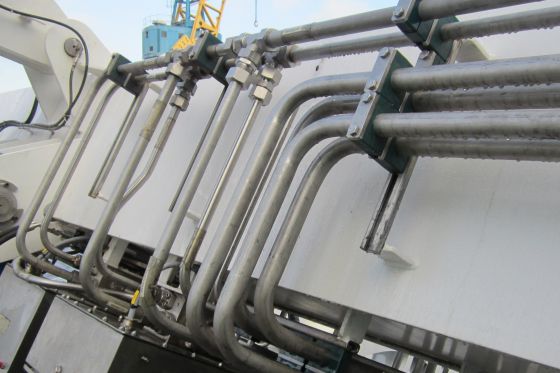
What is the metal cage in STAUFF clamps and what advantages does it offer?
A metal cage in STAUFF clamps is an additional load-bearing metal structure that keeps pipes securely in place even if the plastic clamp body is thermally damaged or destroyed. In this case, the metal components take over the holding function and ensure that pipes remain in position. This significantly increases operational safety, particularly in fire-prone or safety-critical applications.
How the metal cage works in the event of a fire
As temperatures rise, conventional plastic clamps reach their limits due to their design. Plastics lose their mechanical properties or burn completely, thereby compromising their retaining function.
The metal cage specifically counteracts this risk. The load-bearing metal structure remains stable even under high thermal loads and continues to hold the pipe in position. Even if the plastic body fails, the surrounding metal components provide a mechanical safety mechanism.
This ensures that pipes remain in a controlled position and do not sag or break away uncontrollably. Particularly in industrial plants with high safety requirements, this reduces potential consequential damage and, in an emergency, prolongs the stability of the entire system.
Safety advantages over purely plastic solutions
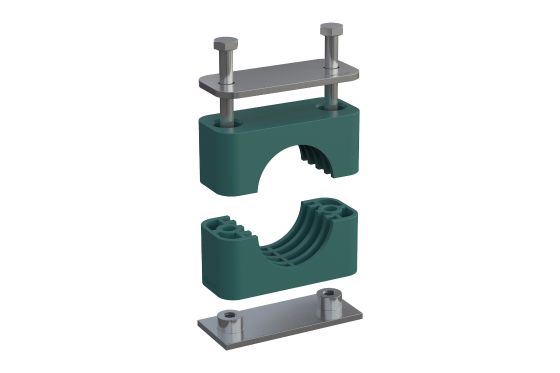
The key difference compared to purely plastic-based fastening solutions lies in the additional mechanical redundancy. Whilst plastic is primarily designed for damping and support under normal operating conditions, the metal cage adds a second, independent level of security to the design.
This combination offers several advantages. The structure remains stable even under extreme loads and is therefore particularly suitable for high-risk applications, such as in mechanical engineering, plant engineering or offshore environments. At the same time, long-term operational reliability is improved, as mechanical and thermal stresses are less likely to lead to failure.
Furthermore, the design combines the positive properties of both materials. Plastic continues to provide vibration damping and material-friendly mounting, whilst metal ensures structural integrity under critical conditions.
This additional level of safety also plays an important role in shipbuilding and in submarines. In such applications, escape and rescue routes must remain as unobstructed and safe as possible, even under exceptional stresses. The mechanical securing of the pipes reduces the risk of pipework falling and blocking escape routes or creating additional hazards in the event of a fire.
Design and integration into clamps in accordance with DIN 3015
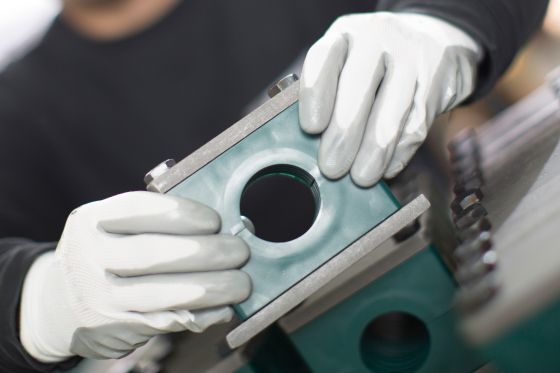
STAUFF clamps from the Standard and Heavy-Duty series in accordance with DIN 3015 are based on a modular design that enables safe and flexible cable routing. Such clamps are regarded as an established system for securing pipes, hoses and cables in industrial applications.
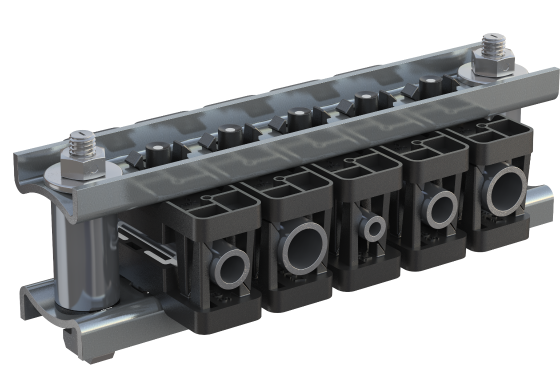
The typical design comprises a plastic clamp body and several metal components which together form the load-bearing structure. These include, in particular, welded plates or support rails, cover plates and the corresponding screw connections. Together, these elements form the mechanical unit of the fastening.
The metal cage is not formed by a separate component, but rather by the interaction of these metal components. They functionally enclose the clamp body and ensure that the retaining function is maintained even independently of the plastic. This principle makes efficient use of the existing design and requires no additional system components.
Material options for increased temperature and corrosion resistance
In addition to the standard version with a plastic clamp body, alternative materials are available for many applications. These include, in particular, aluminium and stainless steel, which offer additional advantages depending on the operating conditions.
Metal variants are characterised by significantly higher temperature resistance and are therefore suitable for environments subject to extreme thermal stresses. At the same time, they offer increased mechanical stability and resistance to external influences.
Stainless steel is used in particular where aggressive media or corrosive environments are a factor. Aluminium, on the other hand, offers an excellent weight-to-strength ratio, making it an attractive option for applications where both strength and weight optimisation are important.
By selecting the appropriate material, the system can be specifically adapted to the respective requirements and further optimised.
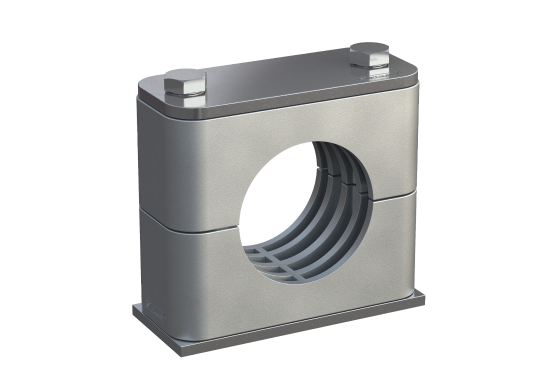
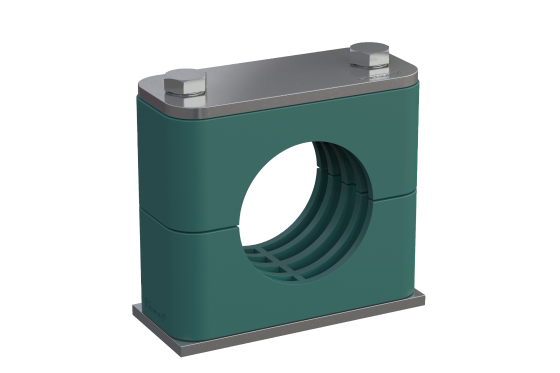
For applications with increased fire safety requirements, flame-retardant materials such as PP-V0 and PA-V0 are also available. These materials are designed to slow the spread of flames and maintain the functionality of the fastening solution for as long as possible under critical conditions. In combination with the metal support structure, this results in a fastening system that meets both mechanical and fire safety requirements.
Practical example: ACT-MLC for the oil and gas industry
For particularly demanding applications in the oil and gas industry, STAUFF has developed the ACT-MLC, a specialised clamp solution. It is based on the same safety principles as the metal cage in clamps to DIN 3015, but is specifically designed to meet the increased requirements of safety-critical installations.
Whilst the metal cage in DIN 3015 clamps is formed by the interaction of the support rail or welded plate, cover plate and bolts, the ACT-MLC has been specifically designed for applications where fire safety, operational safety and reliability are of the utmost importance.
The ACT-MLC thus exemplifies how the principle of mechanical redundancy can be further developed for particularly demanding industrial environments.
FAQs
What is meant by a metal cage in STAUFF clamps?
The metal cage refers to the load-bearing structure comprising a welded plate or support rail, cover plate and bolts, which functionally surrounds the clamp body and takes over the holding function in the event of an emergency.
Why is the metal cage crucial in the event of a fire?
Because it ensures that cables remain securely fastened even if the plastic clamp body is damaged or destroyed by heat.
What are the advantages of this design compared to all-plastic clamps?
The combination of plastic and metal provides both vibration damping and structural integrity under extreme conditions, thereby reducing the risk of complete failure.
In which applications are such clamps particularly useful?
They are particularly suitable for safety-critical applications in mechanical engineering, plant engineering, offshore sectors or in facilities with an increased fire risk.
Are there alternatives to the plastic clamp body?
Yes, depending on the requirements, variants made of aluminium or stainless steel are also available, offering greater temperature resistance and corrosion resistance.

Newsletter Sign-up
Sign up now and never miss another post!